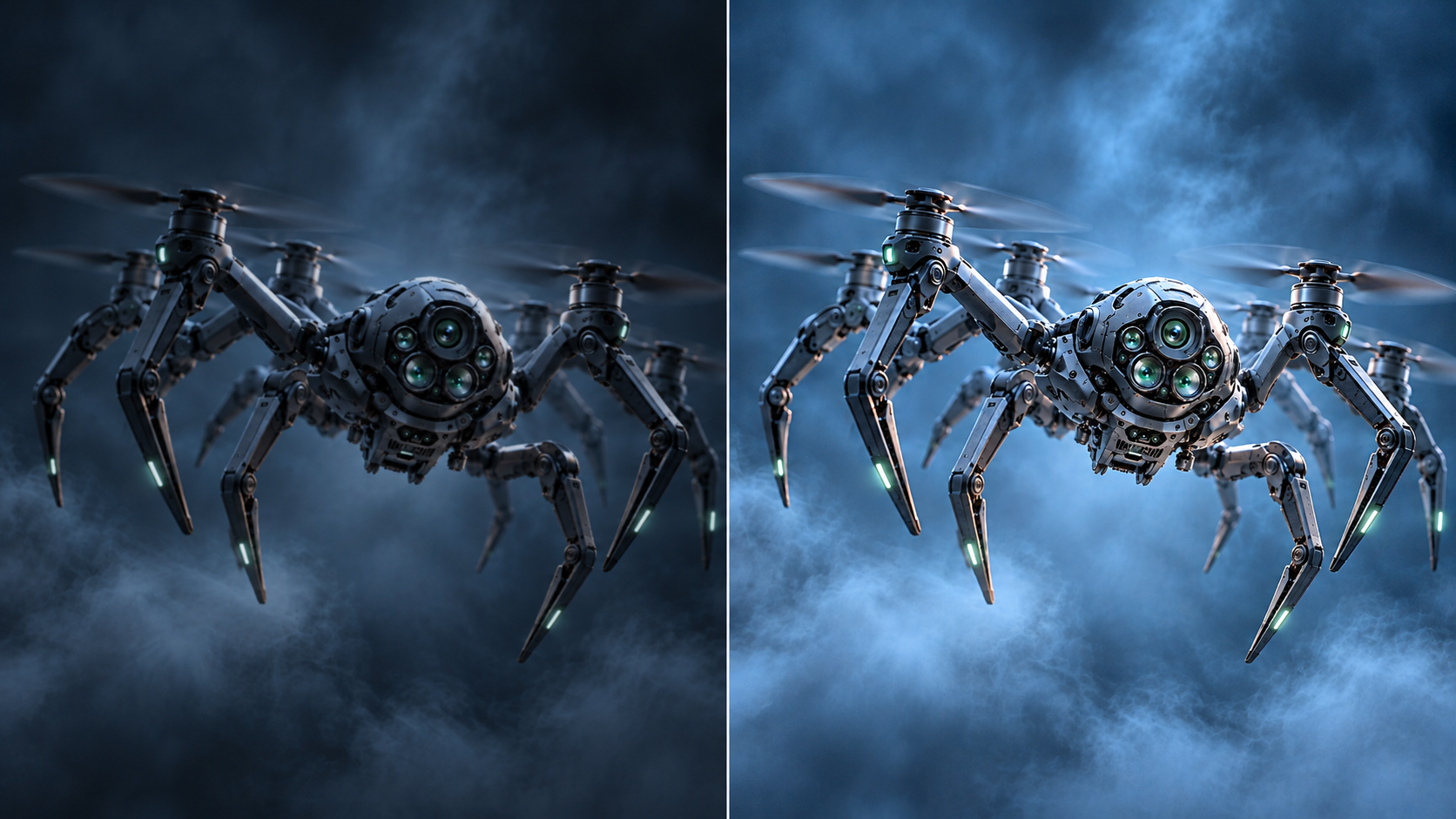
Flight control makes an aircraft possible. Perception, interpretation and learning may make it genuinely autonomous.
From an unexpected lesson in AI history to multimodal vision and two complementary ideas on the vulnerabilities and resilience of autonomous systems.
Research direction · Engineering groundwork exists
See better. Understand better. And vice versa.
The next breakthrough is not simply a better drone. It is a smarter drone.Beyond hardware & control → intelligence
01 / ORIGINS
An old idea — and an unexpectedly modern lesson
Long before today’s autonomous aircraft, Stanisław Lem explored a future in which intelligence, scale and the organization of many small machines could change the nature of technological power. His Summa Technologiae and The Invincible remain provocative starting points for thinking about distributed systems.
In 1981, a much more concrete example appeared. Douglas Lenat’s EURISKO helped design a fleet for the science-fiction Traveller: Trillion Credit Squadron wargame. Rather than imitate established design habits, the human–AI system explored the rules and discovered a different fleet architecture: many comparatively inexpensive ships, substantial protection and numerous smaller weapons, rather than concentrating resources in a few sophisticated vessels.
It won the 1981 tournament. After rule changes it developed another solution and won again in 1982. The demonstration occurred in a simulated game, not a real-world drone trial. Yet the lesson is tangible: sometimes the winning advance is not a better component but a different way of organizing the whole system.
1960s
Lem: a conceptual horizon
Distributed machines and emergent behavior enter the imagination before technology can realize them.
1981–1982
Lenat: the demonstrated reversal
EURISKO’s unconventional simulated fleets outperform familiar designs in two competitive tournaments.
TODAY
The next question
What happens when autonomous platforms acquire better ways to perceive, understand and adapt?
The lesson is not that “more small machines” always wins. It is that a change of concept can be more decisive than another increment of technical performance.
02 / THE NEXT STAGE
Technology is a foundation, not the destination
Improved motors, sensors, controllers, communications, navigation and manufacturing have made modern drones remarkably capable. These achievements are essential. They are not the end of the story.
Competition that remains confined to known specifications can become an expensive race along the same path. A more consequential opportunity is to change what the system is capable of doing: not merely follow instructions or execute a preselected route, but interpret a changing environment, revise assumptions and choose what to do next.
This is why waiting until a technological shift becomes impossible to ignore is dangerous. By the time the need is obvious to everyone, the advantages may already belong to those who explored the next level earlier.
03 / PERCEPTION
Seeing is not the same as understanding
For a genuinely autonomous system, vision is not merely a camera feed sent to a detector. It is the first layer of an ongoing process: acquire evidence, recover structure, compare interpretations, act, and look again.
Better sensory input supports better understanding. The reverse matters just as much: a system that understands what it is trying to discover can decide where to look, which sensing modality to prioritize and what new observation would resolve an uncertainty.
01Sensevisible, IR, thermal, LiDAR
02Enhance & fuserecover usable information
03Representshape, motion, geometry
04Understandhypotheses & context
05 ↺Act & learndecisions guide new sensing
Visible imaging
Texture, color, fine detail — but vulnerable to illumination, glare and smoke.
Infrared & thermal
Complementary information when visible contrast is weak or incomplete.
LiDAR & geometry
Spatial structure, depth, surfaces and relationships in 3D.
Fusion & tracking
Bring observations and motion together to build a more stable situation model.
Engineering groundwork, not a hypothetical promise
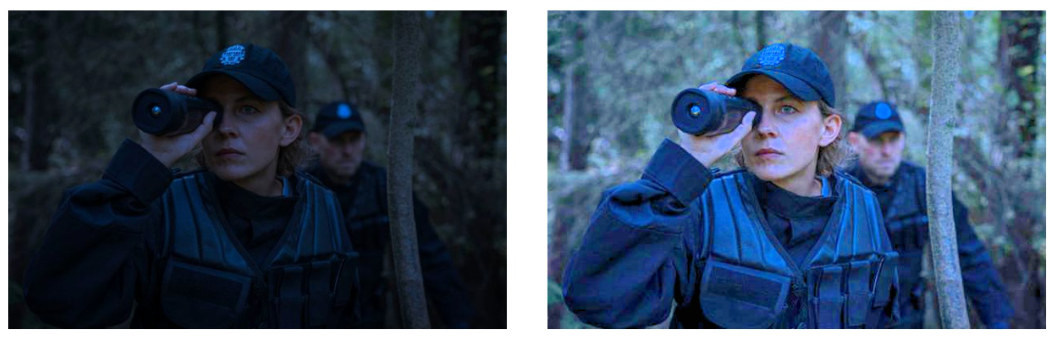
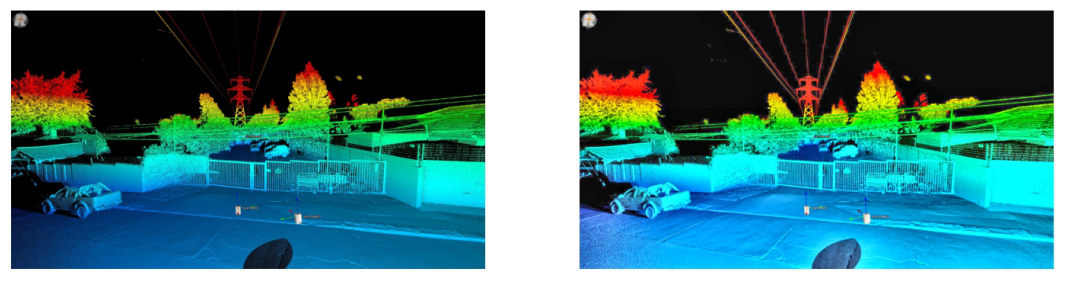
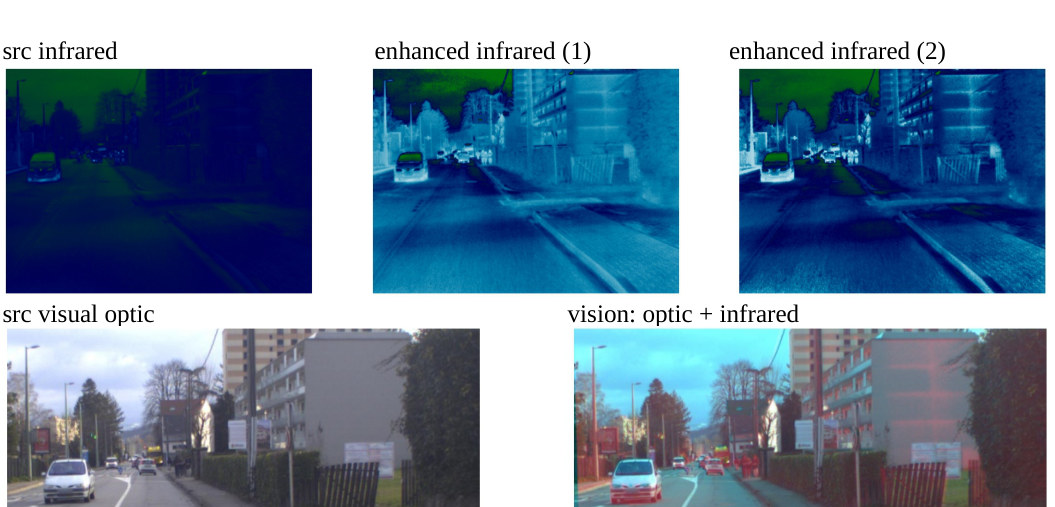
VIC·TORI’s existing work includes modality-independent image enhancement, geometric and object detectors, tracking, and frame-by-frame 2D-to-3D reconstruction. These are real technical components and experiments; they are not presented as an already integrated autonomous drone platform.
Low-light visual informationOriginal vs. enhanced images. Existing image-processing examples; better visibility can improve the evidence available to later reasoning.LiDAR structureExisting enhancement examples in a spatial data modality. Not a claimed autonomous driving or flight test.Cross-modal evidenceVisible optics, enhanced infrared and illustrative fusion from the original R&D material.
The next layer begins where a detector ends. Information from several sensors, detectors and trackers can support multiple, sometimes conflicting hypotheses about a scene. A more intelligent system must evaluate them, update its situation model, choose an action, observe the consequences and learn from the result.
The research directions in the underlying proposal include heuristic reasoning, specialized statistical models, digital twins for exploring possible situations, and the ability to revise the models themselves. No single technique is claimed to be a complete answer.
Autonomy is not just “no human holding the controller.” It is a persistent connection between perception, understanding, decision, action and experience — including the ability to recognize when the available evidence is insufficient.
05 / TWO IDEAS
The sword and the shield
Once perception becomes central to autonomy, its vulnerabilities and alternative forms of communication become strategic engineering questions. The original proposal raised two complementary research ideas — one exposing a weakness, the other seeking a new form of resilience.
Idea A · The sword
When vision itself is interrupted
A non-destructive optical-interference concept: aerosol-borne obscuration could temporarily degrade the visual input of camera-based autonomous systems without destroying the platforms themselves. This is a research proposal, not a tested method.
The corresponding defensive challenge is equally important: protection and cleaning of optical surfaces, recovery of sensor quality, redundant sensing and recognition of degraded conditions. These ideas concern the dependence of intelligent behavior on trustworthy perception.
Status: conceptual proposal. The original text does not establish demonstrated effectiveness, operational suitability or validated safety.
Idea B · The shield
Communication through behavior
Biological systems sometimes communicate through movement, gestures or collective patterns. Could an autonomous group use observable behavior as an additional communication channel when ordinary electronic communication becomes unreliable?
This requires more than mimicry. A useful system would need shared interpretations, reliable observation, coordination under uncertainty and explicit ways to avoid ambiguous signals. It is a possible layer of resilience, not a replacement for all communication systems.
Status: conceptual proposal. No validated swarm-communication implementation is claimed.
These concepts address different failure modes. A visual behavioral channel does not automatically solve optical blindness; resilience requires independent pathways, awareness of failure and an ability to adapt.
The next question
The first necessary stage is behind us. The decisive work is ahead.
Hardware, flight control, manufacturing and reliable operation are indispensable achievements. Yet they are only the foundation for a more demanding task: systems that can see, understand, learn and act autonomously.
VIC·TORI is interested in partners who want to investigate this transition seriously — bringing real engineering problems, experiments, constructive criticism and resources for joint R&D.
If you do not begin working on the next level, someone else will.
This page presents an engineering perspective and early research concepts, not a claim that an autonomous drone system, optical countermeasure or behavioral swarm protocol has been field-tested. Illustrations are extracts from VIC·TORI's source material, Competitive Advantages (July 2025).